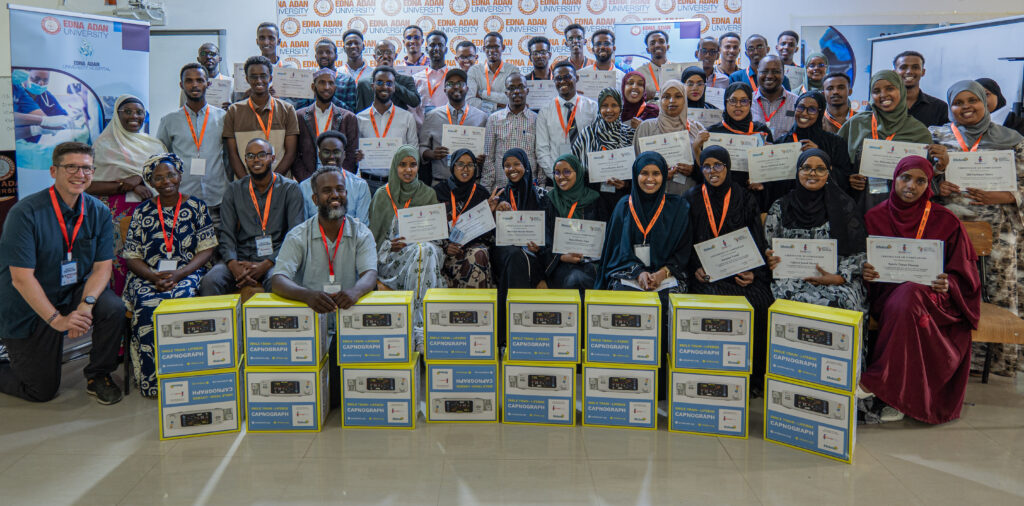
Every operating room in Somaliland that needed a capnograph now has access to one. This marks a remarkable change from 2020, when capnography was virtually unavailable across Somalilland. Following a fundraising effort led by Dr. Gregory Sund and Ella Sund, in partnership with Mubarak Mohamed, local clinical leaders, and anesthesia residents across the world, 62 capnographs have been delivered to hospitals across Somaliland, while 54 anesthesia providers have received hands-on training to use, interpret, troubleshoot and maintain the devices.
Capnography monitors a patient’s breathing during anesthesia and immediately flags if breathing stops, an airway blocks, or a breathing tube is misplaced. Without it, providers had to rely on clinical observation alone to catch emergencies that can turn fatal in minutes. Capnography has been a standard component of anesthesia in many high-income countries for decades. Yet access remains limited in many low-resource settings.
Until recently, Somaliland was one of them.
Building Access, Strengthening Practice
When Dr. Gregory Sund travelled to Somaliland in 2020, he saw the gap firsthand. Hospitals were providing surgical care, but anesthesia teams lacked access to a monitor that colleagues elsewhere in the world routinely depend on. That experience prompted Dr. Gregory and Ella Sund to begin exploring how they could help make capnography available to anesthesia teams across Somaliland. But closing this capnography gap needed more than purchasing devices.
Working alongside Mubarak Mohamed, and other local clinical leaders, the initiative identified where capnographs were needed and planned how devices and training could reach operating rooms across Somaliland. The effort grew as supporters came together around the same goal. Gregory and Ellah led a fundraising campaign that funded the first 40 capnographs. Anesthesia residents participating in the ASA-Lifebox Resident Challenge provided an additional 22 devices. Lifebox supported the logistics needed to get the devices to hospitals. What began with clinicians identifying a critical patient-safety need became a collaborative effort to close that gap in Somaliland.
Training was central to the effort: providers learned to use, interpret, troubleshoot, and maintain the devices. The aim was not simply to distribute the devices but to build lasting capacity needed to integrate capnography into everyday anesthesia care.
"When I first came to Somaliland in 2020, there was not a single hospital that had capnography. Now, we're able to provide at least one capnography machine for every operating room. This is going to change the safety of all patients having surgery in the years to come."
Dr. Gregory Sund, Head of Anesthesia, AIC Kijabe Hospital, Kenya
A Model, Not an Endpoint
Somaliland shows what’s possible when a clinical need is recognized and people with different roles and resources come together to meet it. But the challenge is far bigger: more than 70% of operating rooms across sub-Saharan Africa still lack access to capnography. Somaliland isn’t a problem solved once and for all. It is proof that the gap isn’t inevitable, and that coordinated action can close it.
Thank you to Dr. Gregory and Ella Sund, Dr. Mubarak and Somaliland’s clinical leaders, the anesthesia residents of the ASA–Lifebox Resident Challenge, and every donor who made this possible. The opportunity now is to bring what Somaliland has shown is possible to more operating rooms, and the patients who depend on them.